

Sensors mounted wirelessly, put into clean operation
Once the monitoring concept is complete, we mount the sensors at the structure. Wireless instead of wired, without major interventions, with clean commissioning and baseline measurement, so usable data runs from day one.
- Without cables or drilling
- Baseline measurement documented
- Reusable sensors
Full-service process
Advantages of the mounting
Mounted wirelessly, without intervening in the structure
Our sensors are wireless. No power or data cables to the sensors are needed. This simplifies mounting, avoids interventions and makes the sensors reusable if required.
Wireless instead of cables
No cable trench, no connection to the building infrastructure. The sensors transmit via Narrowband IoT or through a local gateway.
Low-impact mounting
Where the measuring task allows it, we mount using an adhesive mounting plate with a clip system, entirely without drilling into the component.
Baseline measurement included
The first documented reading maps the starting condition against which all later changes are compared.
Reusable
Once a monitoring task is complete, a sensor can be released and reused at another structure.
Installation day
From mounting to the baseline measurement
Fixing alone is not enough. Only the baseline measurement makes later changes assessable. See how the starting value is established.
- 01 Site visit
Measuring points prepared
- 02 Mounting
Sensor fitted
- 03 Commissioning
Thresholds stored
- 04 Baseline measurement
Starting value recorded
The baseline measurement is the quiet core of a clean installation. Without a defined starting point, a crack movement, a tilt or a settlement could not be reliably assessed, because the reference value would be missing.
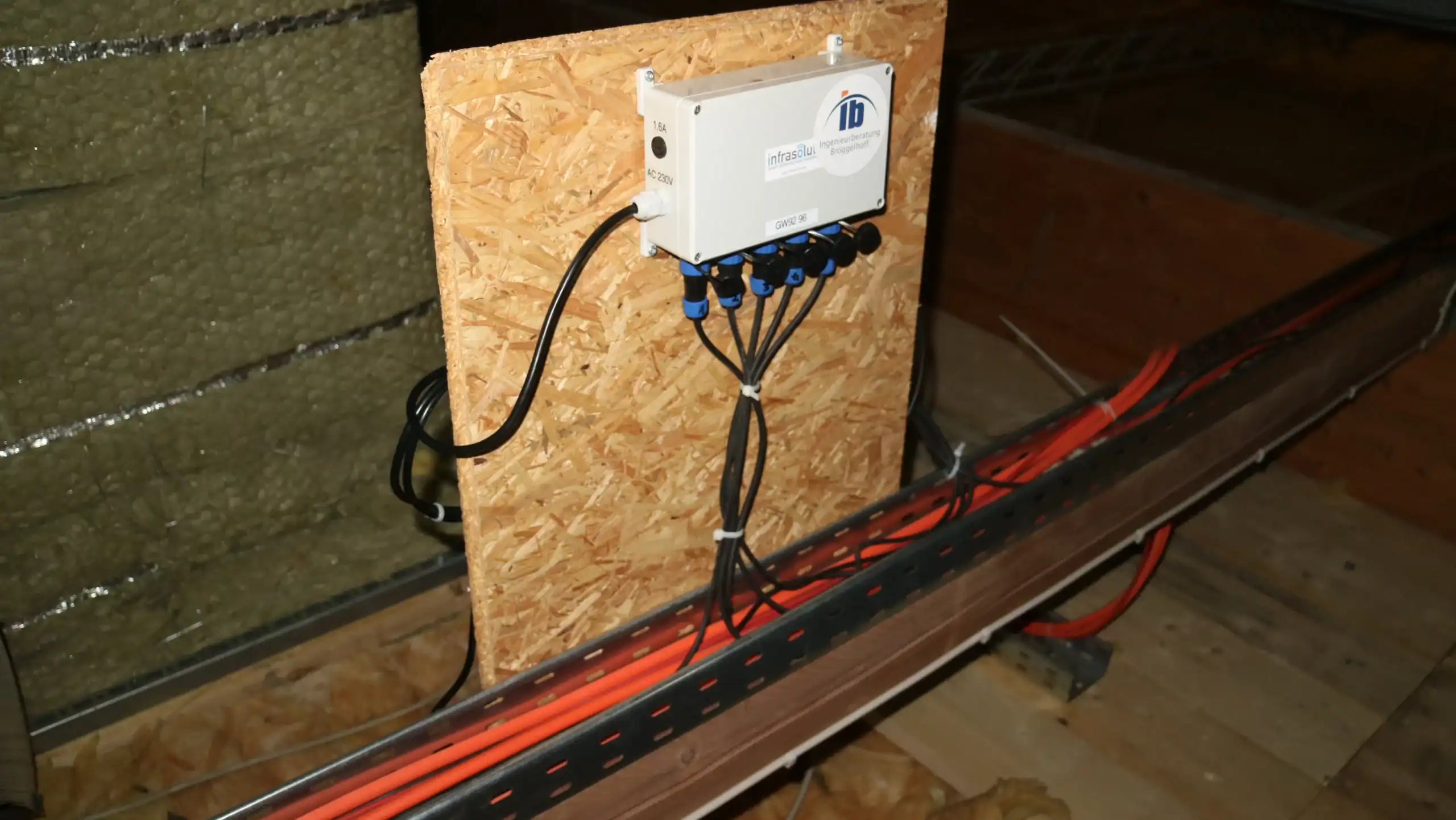
Installation process
From the site visit to handover
- 01
Site visit and preparation
We walk the measuring points set out in the monitoring concept at the structure, check accessibility and the substrate, and prepare the mounting positions. This makes it clear on installation day which sensor goes where.
- 02
Mounting with minimal intervention
The sensors are mounted wirelessly and largely non-destructively. Where possible, adhesive mounting plates are used instead of drilling. No power or data cables to the sensors are needed.
- 03
Commissioning and baseline measurement
We register every sensor on the data platform, store the warning and alarm thresholds defined in the concept, and record a baseline measurement as the starting value against which all later changes are compared.
- 04
Handover into monitoring
Once every measuring chain is delivering clean data, the installation moves into ongoing operation. On request, we take over maintenance and monitoring as a service.
Scope of service
What we handle during installation
From the site visit to handover into monitoring. Every measuring chain is checked before handover, every starting value documented.
One point of contact
Installation is a building block of a continuous process. You get the chain from a single source, without interfaces where responsibility gets lost.
- Site visit and preparation of the measuring points
- Wireless mounting without power and data cables
- Low-impact fixing, where possible with an adhesive mounting plate
- Integration of the sensors on the data platform
- Storing the warning and alarm thresholds from the concept
- Baseline measurement as a documented starting value
- Function test of every measuring chain and handover into monitoring
Everything from a single source
A building block of a continuous process
Installation sits between the concept and ongoing operation. You get this chain from a single source, so the sensors sit where they deliver a finding, and work cleanly from the start.
- 01
Concept
Monitoring concept, sensor selection, measuring points and thresholds, aligned with DIN 1076.
Learn more - 02 You are here
Installation
Wireless mounting of the sensors and commissioning with a documented baseline measurement.
Learn more - 03
Maintenance and operation
Data platform, sensor maintenance and battery replacement as monitoring as a service.
Learn more - 04
Monitoring and alerting
Ongoing evaluation with automatic alerting by email and SMS.
Learn more
We mount your sensors
Describe your structure to us. If the monitoring concept is ready, we plan the installation day. If it is not yet ready, we start with the concept.
 Roman Koch
Data platform
All readings on one platform
The sensors transmit their readings wirelessly to the data platform, where they are evaluated, documented and continuously checked against your thresholds.
- AI-assisted data analysis
- User-focused reporting
- Continuous evaluation
- Warning and alarm thresholds
- Alerts by email and text message
- Remote access around the clock
- AI-assisted data analysis Condition within limits
- User-focused reporting Report ready
- Alerting Thresholds monitored
Before and after in the process
How installation fits into the process
The mounting positions follow from the measuring point plan of the concept. After commissioning, the installation moves into ongoing operation.
Concept
Measuring points, sensor selection and thresholds are defined here. Installation implements exactly this plan.
To the concept After, step 03Maintenance and operation
Data platform, alerting, reports and the upkeep of the sensors: ongoing operation after handover.
To maintenance and operationFrequently asked questions
Are structural interventions needed for the mounting?
What is a baseline measurement and why does it matter?
Why wireless instead of cables?
Can I mount the sensors myself?
What happens after installation?
Project inquiry
We bring your sensors to the structure
Describe your structure and measuring task to us. We align the mounting process with your task and get back to you shortly.
+49 6742 8599600 DE +41 41 670 00 11 CH [email protected]