

Temperature monitoring: every measuring point at the same time
Capture component and air temperatures on bridges and structures wirelessly, during construction and in service. For surveying, bearing adjustment and erection, and as the basis for evaluating crack width, tilt or deflection corrected for temperature.
Your benefits
The temperature of the component, not the weather report
A steel girder in the sun is considerably warmer than the air, and its shaded bottom flange cooler than its top flange. Anyone surveying, adjusting bearings or assessing readings needs these differences as measured values.
Request a quoteEvery measuring point at the same time
Surveying and bearing adjustment need the temperature at the moment of measurement, across the whole structure. The readings of all sensors share one time axis and can be accessed at any time.
No cables across the structure
Each measuring point has a wireless measuring node, with the sensors attached by short leads. The mesh radio reaches the gateway, and no cables are run across the bridge.
Temperature differences in the cross-section
Four sensors per measuring point on the top and bottom flange and the outer and inner web give the mean component temperature and the differences across the height and width of the cross-section.
Clean values for every other measurand
Crack width, tilt, deflection and bearing displacement follow the temperature. With the measured temperature, this share can be removed, leaving the change the structure itself shows.
Three methods
Three methods: on the component, with a weather station or via the German Weather Service
The three methods provide different temperatures and answer different questions. Which one fits depends on whether the temperature of the component itself is needed or whether other measurands are to be corrected.
Method 1 · On the component
Temperature sensors at the measuring points
Thermistor sensors (NTC) directly on the component surface, read by battery-powered wireless measuring nodes with four channels. Air temperature is measured by a sensor in a ventilated radiation shield. In concrete components, the embedded CorroDec sensors also measure the temperature directly in the concrete.
- Accuracy ±1 K, resolution 0.1 K
- Measuring range −40 to +85 °C
- Measuring interval adjustable from 1 s to 1 h
- Sensors fixed on the coating, no drilling
- In concrete: CorroDec sensors also measure temperature
Fits when the component temperature itself is needed, for example in steel construction, surveying and bearing adjustment.
Method 2 · On the structure
Weather station
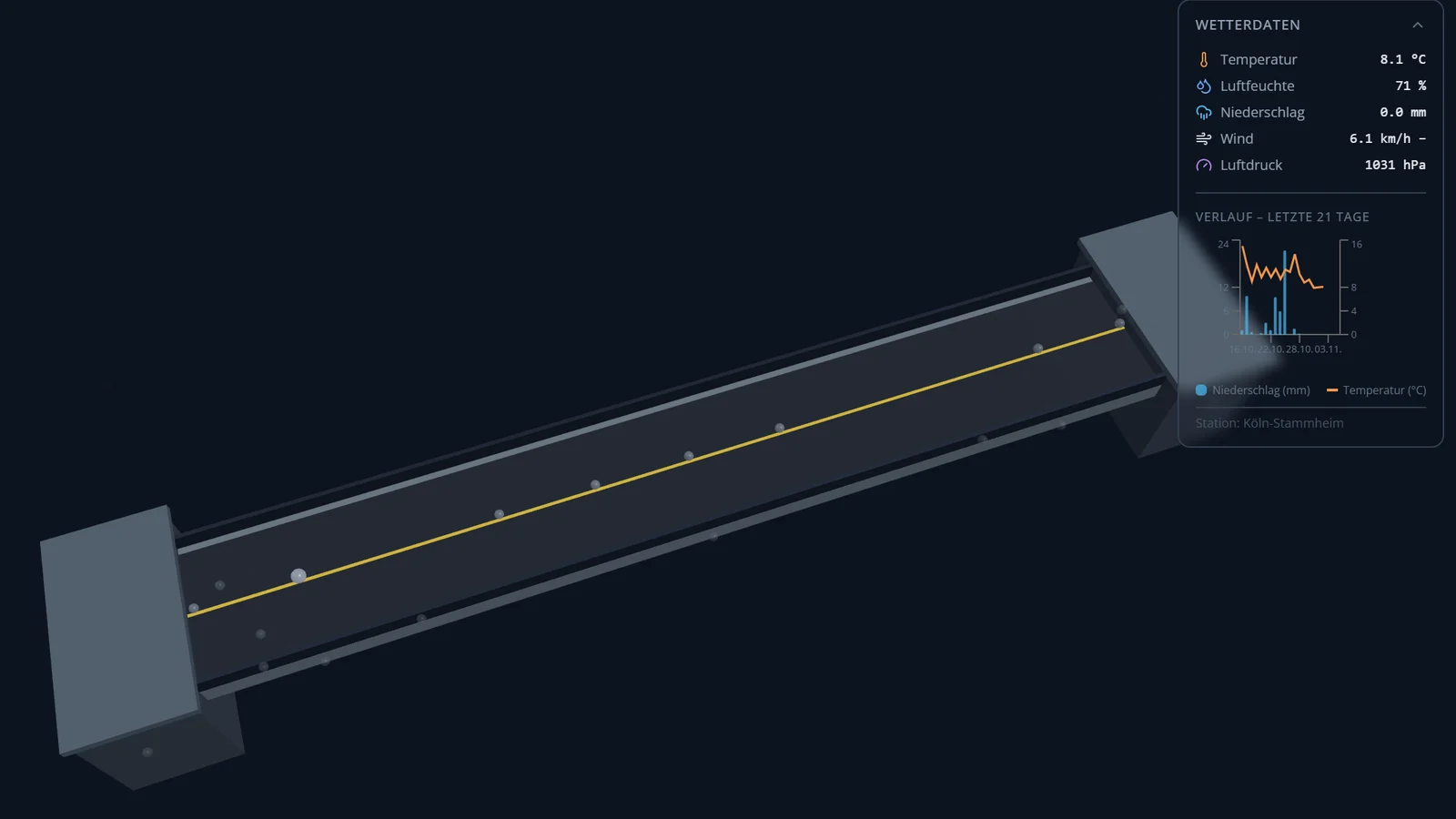
A compact weather station on the structure records the conditions exactly where measurements are taken and transmits its readings via the same gateway as the other sensors.
- Air temperature and humidity
- Precipitation
- Wind speed and direction
- Air pressure and global radiation
Fits when weather and solar radiation on site are to be measured as a cause.
Method 3 · No extra device
German Weather Service data
The German Weather Service (DWD) publishes the readings of its stations as open data. In the analysis, we use the nearest station and apply the temperature correction with it.
- No additional device on the structure
- Also retrospectively for existing data series
- Air temperature at the station, not the component
- Distance to the structure is taken into account
Fits when an existing crack, tilt or deflection monitoring system is to be corrected for temperature.
The three methods compared
| Feature | Method 1 Temperature sensors at the measuring points | Method 2 Weather station | Method 3 German Weather Service data |
|---|---|---|---|
| What is measured | Component temperature at every measuring point, plus air temperature | Weather on the structure: temperature, humidity, precipitation, wind, air pressure, radiation | Air temperature at the nearest station |
| Device on the structure | Sensors and wireless node per measuring point, gateway | Weather station, gateway | none |
| Component temperature | yes | no | no |
| Usable retrospectively | no | no | yes |
| Typical use | Steel construction, surveying, bearing adjustment | Weather and sun as a cause on site | Correcting an existing monitoring system |
The methods can be combined, for example sensors on the critical components and a weather station for solar radiation and wind on site.
How it works
From the measurement concept to the temperature table
From the first plan to the last table, everything comes from one source: measuring points, radio, sensor checks and data provided in the format that surveyors and structural engineers need.
- 01
Measurement concept
We define the position and design of the measuring points, the fixing, radio planning and measuring intervals, coordinated with workshop and erection planning or with the existing monitoring.
- 02
Installation and commissioning
Every sensor is tested before installation. After mounting, we compare all channels with a calibrated reference thermometer and activate web access.
- 03
Operation and maintenance
The platform continuously checks the readings for plausibility and reports failures. In quiet night hours we check that the sensors of a measuring point read the same, and suspicious sensors are replaced.
- 04
Data and reports
Readings around the clock in the browser, tables as CSV or Excel in the agreed format, a monthly report and alerts by email or SMS at freely selectable thresholds.
What is analysed
Four sensors, three key values per measuring point
Each measuring point has sensors on the top flange (O), bottom flange (U), outer web (SA) and inner web (SI). They give the key values that structural engineers, surveyors and erection teams work with.
- Mean component temperature Tm = (TO + TU + TSA + TSI) / 4
- Trend over time and deviation from the erection temperature.
- Difference across the height Tz = TO − TU
- Shows how strongly the cross-section is heated from above.
- Difference across the width Ty = TSA − TSI
- Shows how strongly the sun heats one side of the cross-section.
- Comparison with the air temperature
- Comparison between components, e.g. arch and stiffening girder
- Daily minimum and maximum per measuring point
- Statistics and export for your own analysis
Temperature correction
Remove the temperature share, recognise the change
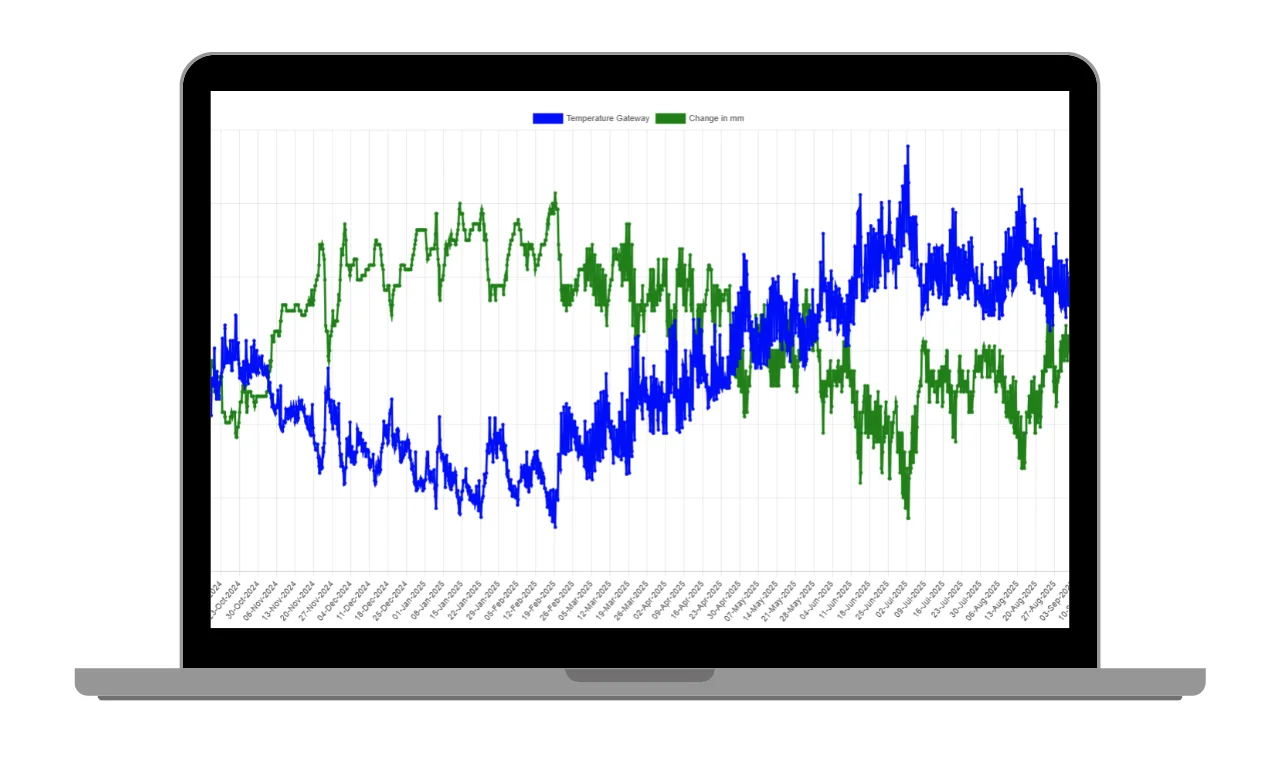
Almost every measurand on a structure follows the temperature: cracks open and close over the day, girders bend, bearings move. Without correction, this share masks the actual change. With measured component temperature, a weather station or German Weather Service data, the platform separates the temperature share from the trend.
From practice
In a project on a motorway bridge, the crack width followed the air temperature with a lag of four to five hours. Only after removing this share did the trend over the weeks become visible.
Temperature is also measured in crack monitoring, bridge bearing monitoring and concrete maturity monitoring. Directly in the concrete, the CorroDec sensors measure it as part of moisture and corrosion monitoring. Structural health monitoring brings all measurands together.
Everything from a single source
One contact for the entire monitoring
From the measurement concept through installation to the ongoing provision of data, we support you throughout the project, as a complete solution, not individual parts.
- 01
Concept
We assess the structure and the question, choose the right way to the temperature and plan measuring points, radio and intervals.
Learn more - 02
Installation
We install sensors, measuring nodes, weather station and gateway, test every channel and commission the system.
Learn more - 03
Maintenance & operation
We keep the measuring equipment operational, check the sensors and respond to faults, on site if needed.
Learn more - 04
Monitoring & alerting
We provide the data, prepare reports and report threshold exceedances and failures.
Learn more
Typical applications
Where temperature decides the result
Whether erection, surveying or assessing a reading: wherever a component responds to heat, its temperature belongs in the measurement.
- Steel and composite bridges during construction: surveying, bearing adjustment, erection stages
- Existing bridges with crack, tilt or deflection monitoring that is to be corrected for temperature
- Bridge bearings whose displacement is read against the temperature cycle
- Concrete components during hardening, when temperature determines maturity
- Structures where weather and solar radiation are to be measured as a cause
Bridge monitoring
From construction to the bridge in service
In steel construction, temperature is the basis for surveying and bearing adjustment; in service, it is the basis for assessing every other measurand between two inspections to DIN 1076.
To bridge monitoringStructural health monitoring
Temperature as part of the overall picture
In structural health monitoring, temperature, cracks, tilt, moisture and vibration come together on one platform. Only together do they show what is cause and what is effect on the structure.
To structural health monitoringMatching sensors
Sensors that also measure temperature
Besides the temperature sensors at the measuring points, our crack sensors and the CorroDec sensors in the concrete also record the temperature, as the basis for correction.
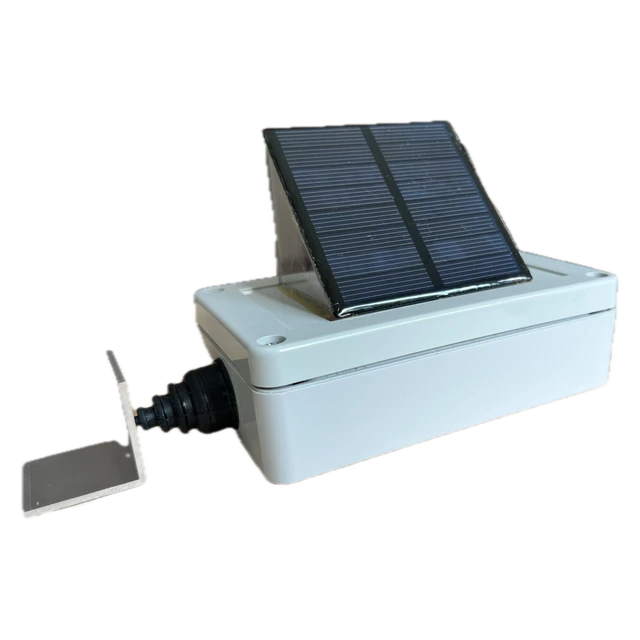 ProductsCrack SensorCrack width and temperature, 0.003 mm resolution, via NB-IoT.
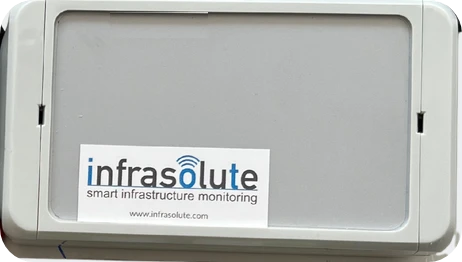 ProductsCrack Sensor LiveCrack width and temperature at 1 to 10 Hz on the live gateway.
 ProductsMoisture Sensor CorroDec 2GConductivity and temperature directly in the concrete, passive via RFID.
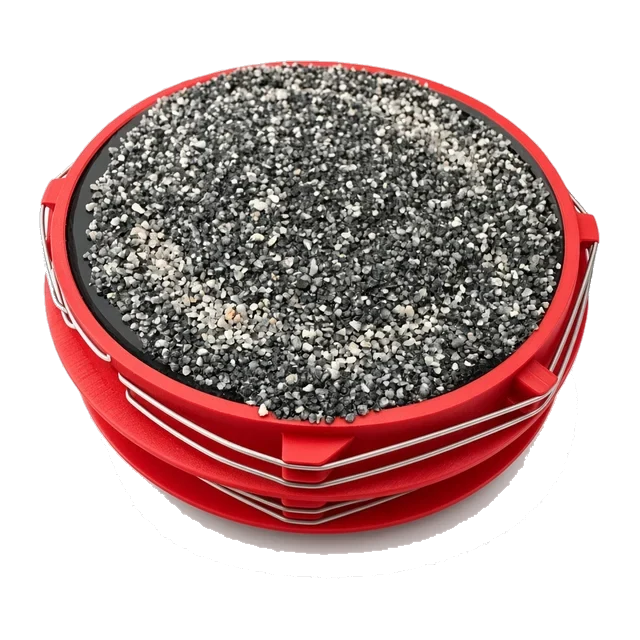 ProductsCorrosion Sensor CorroDec 2GCorrosion progress across two wire levels and temperature in the concrete.
Infrasolute platform
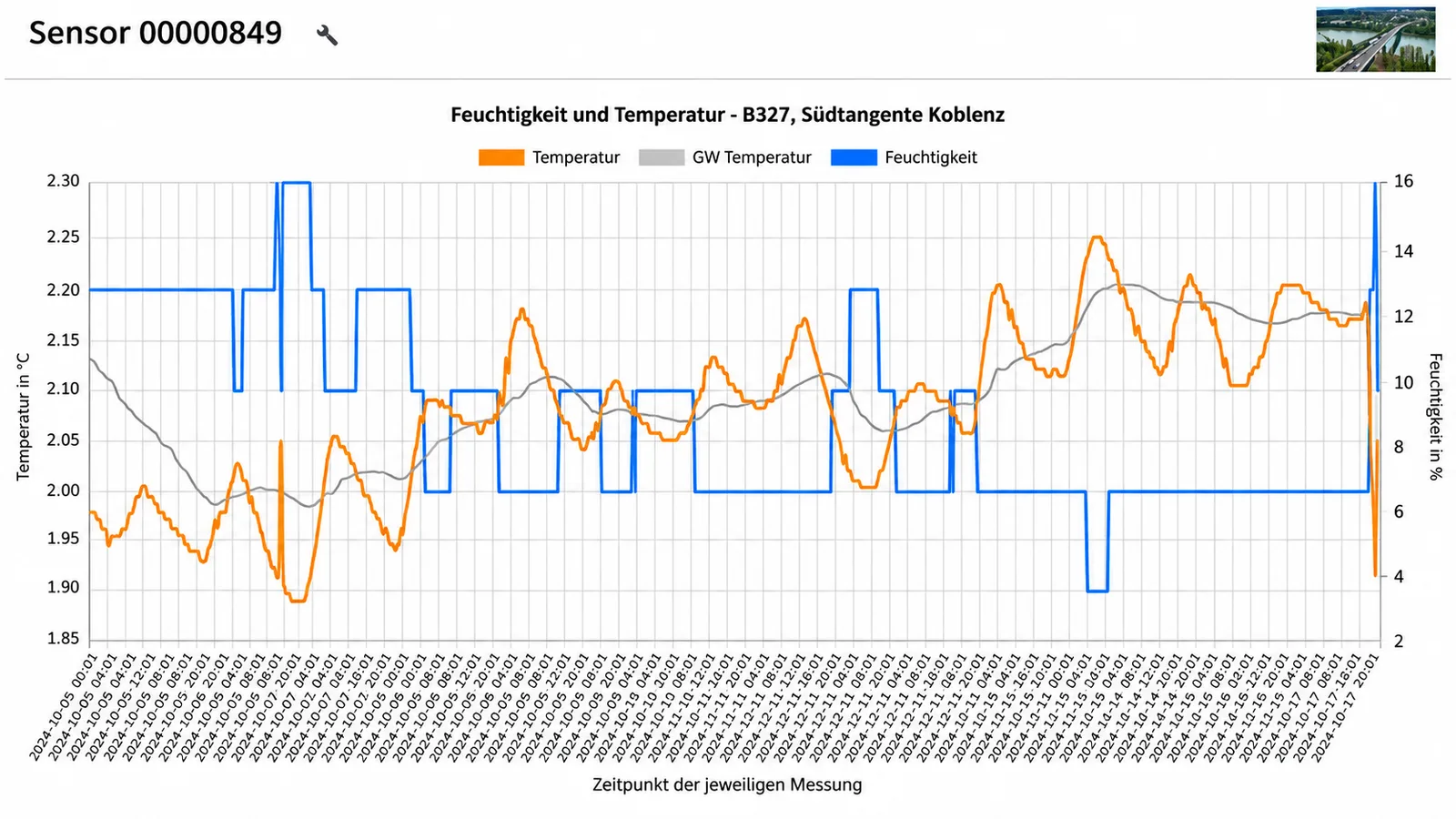
Temperature and readings on one time axis
Analyse temperature trends, read measurands corrected for temperature and separate the trend from the daily cycle.
Platform modules
Temperature monitoring for your structure
Whether a steel bridge under construction or an existing structure with ongoing monitoring: we choose the right way to the temperature and match measuring points, intervals and data format to your question.
 Benedikt Seuss

Frequently asked questions about temperature monitoring
What is temperature monitoring?
Why is the component temperature so important for steel bridges under construction?
How accurate are the temperature sensors?
How are the sensors attached to the component?
Do I need my own weather station?
Can German Weather Service data be used?
How do the data reach us and third parties?
Project inquiry
Let’s talk about your structure
Tell us about the structure, its construction stage or existing monitoring, and the period. You will promptly receive a proposal for measuring points, measuring intervals and data provision.
+49 6742 8599600 DE +41 41 670 00 11 CH [email protected]