
Monitoring that keeps rail operations safe.
Track monitoring to RIL 883.8100A01, plus railway bridges, retaining structures and works in the track area: we capture track geometry automatically, transmit the data remotely and alert proactively, before operations are endangered.
Benefits for railways
Your advantage with railways and rail infrastructure
Whether railway undertaking, infrastructure operator, engineering firm or contractor: a standards-compliant geo-monitoring system creates traceability, keeps operations safe and lets you react immediately to critical movements.
Request a quoteCompliant with RIL
We monitor track and switches to RIL 883.8100A01. Position, level, cant and twist are captured traceably, at the required measuring point density.
Safety in operation
Works in the track environment, drilling and ramming work, or temporary states such as auxiliary bridges stay under control. You see critical changes in track geometry immediately.
Proactive alerting
Data is captured automatically and transmitted remotely. When defined thresholds are reached, the system alerts, so you can react before operations are endangered.
24/7 operation, without your own team
On request, we take over monitoring as an outsourced department: setup, evaluation and alerting around the clock, without tying up your own survey staff.
Live monitor
Track geometry in view, to RIL 883.8100A01
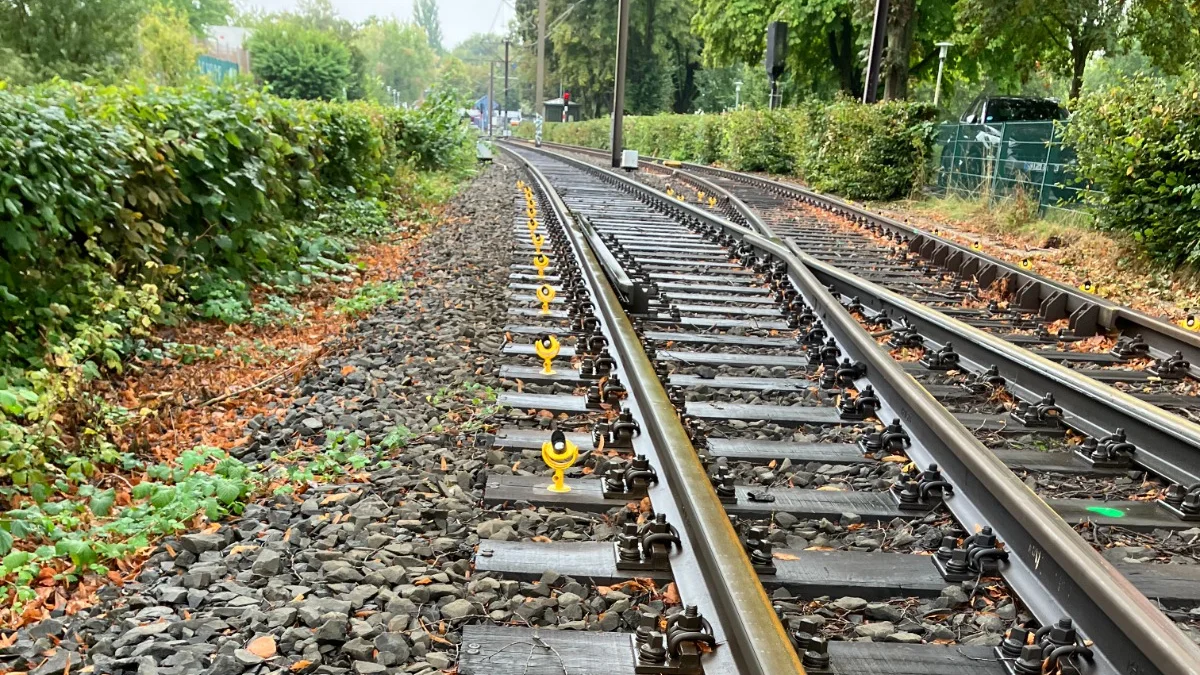
Prisms sit every five sleepers. Start the simulation of ramming work next to the line and see how position, level, cant and twist change until a threshold triggers the alert.
Track geometry status
OnlinePosition
lateral track position
0 mm
Threshold 6 mm
Level
vertical level
0 mm
Threshold 8 mm
Cant
relative level between rails
0 mm
Threshold 10 mm
Twist
twist per base length
0 mm
Threshold 8 mm
Schematic illustration, not measurement data
Areas of application
Where monitoring is needed on the railway
From site conditions in the track environment to railway bridges and retaining structures: we monitor the points where movement can endanger rail operations.
Works in the track environment
Continuous capture of track geometry during construction phases, before settlement and shifts become critical.
Drilling & ramming work
Early detection of the smallest positional changes from interventions in the subsoil next to the line.
Auxiliary bridges
Monitoring of cant, twist and positional changes on temporary structures.
Switches & crossings
Geo-monitoring for track and switches to RIL, including on special constructions.
Railway bridges
Crack widths, tilt and deformation on railway overpasses, continuous and tied to the standard.
Retaining structures
Monitor retaining walls and embankments along the line for shifting and tilting.
The heart of every railway application is standards-compliant track monitoring. Details, measurement concept and process are on the solution page.
Go to track monitoringRIL 883.8100A01
Track monitoring that meets the standard
RIL 883.8100A01, Deutsche Bahn’s guideline for track monitoring, defines minimum requirements for measurement and evaluation in geo-monitoring of track and switches. We implement these requirements with high-precision total-station monitoring.
For railway overpasses and engineering structures, the infrastructure operator’s regulations also apply additionally, for example RIL 804 for railway bridges. We align the measurement concept with this.
Four mandatory quantities
At minimum, position, level, relative level between rails (cant) and twist are monitored. Within the hazard analysis, the scope can be extended, for example to gauge or absolute track geometry.
Measuring point density
Prism targets are placed at an interval of five sleepers per rail, typically every 3.00 m with a 60 cm sleeper spacing.
Measuring range
The monitored range extends at least 25 m beyond the area of possible change and is extended on a project-specific basis.
Total-station monitoring
Automated measurement cycles capture the prisms in the sleeper grid with high precision. Evaluation is robust and transmitted remotely, for continuous monitoring and alerting.
One point of contact
The whole monitoring from a single source
From concept through installation in the sleeper grid to maintenance, operation and ongoing alerting: you do not coordinate separate trades, you get a complete solution.
Concept
From the hazard analysis and standard reference, we derive measuring quantities, point grid and thresholds, and align them with the operator and construction supervision.
Learn moreInstallation
Prisms and sensors are placed in the sleeper grid and commissioned, with a documented baseline measurement as a reference.
Learn moreMaintenance and operation
We keep the measuring equipment operational and continuously evaluate track geometry, on request as an outsourced department.
Learn moreMonitoring and alerting
All quantities come together around the clock. When defined thresholds are reached, the system alerts automatically, without manual on-site checks.
Learn moreMatching sensors
This sensor technology sits along the line
Alongside total-station monitoring of track position, these devices are used on structures along the line.
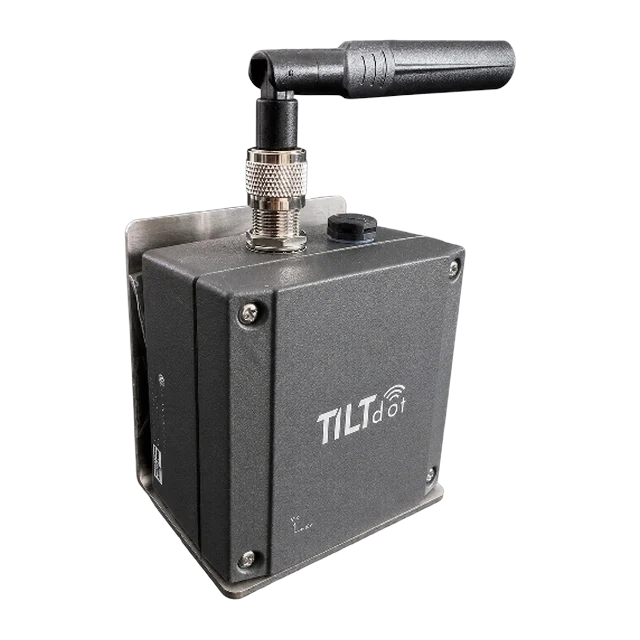 ProductsTilt sensorTilt and settlement of load-bearing components from 0.001°, gateway integrated.
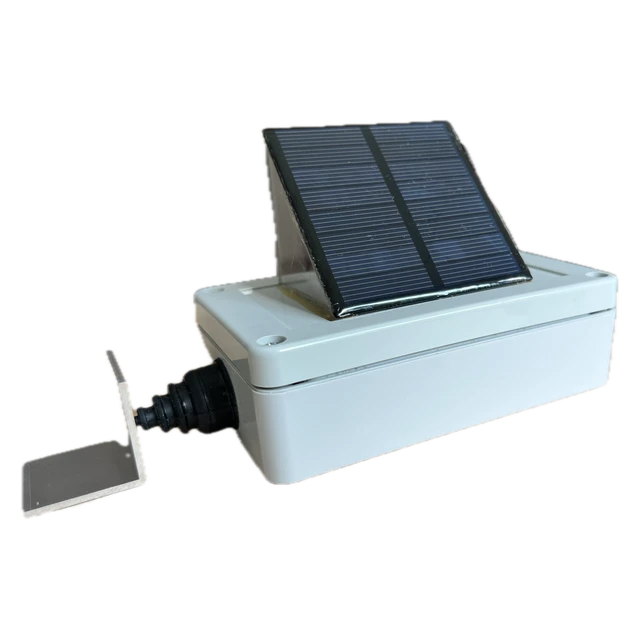 ProductsCrack sensorCrack width with 0.003 mm resolution, available with solar, long-life battery or mains power.
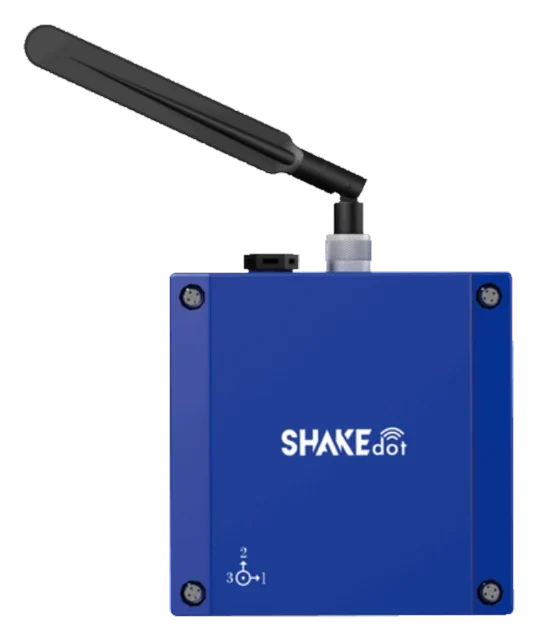 ProductsVibration sensor SHAKEdotThree-axis vibration measurement to DIN 4150-3, autonomous for up to six months.
Monitoring in the track environment
Works on the track, a railway bridge or a retaining structure: tell us about the project. We will propose a measurement concept to RIL 883.8100A01.
 Peter Nater
Data platform
All readings on one platform
The sensors transmit their readings wirelessly to the data platform, where they are evaluated, documented and continuously checked against your thresholds.
- AI-assisted data analysis
- User-focused reporting
- Continuous evaluation
- Warning and alarm thresholds
- Alerts by email and text message
- Remote access around the clock
- AI-assisted data analysis Condition within limits
- User-focused reporting Report ready
- Alerting Thresholds monitored
Basis for decisions
What you can decide in the railway environment
In rail operations, possessions are scarce and speed restrictions are costly. Both are decisions that depend on track position and the structural condition.
- 01
Impose or lift a speed restriction
The track position measured to RIL 883.8100A01 proves whether a speed restriction is needed and when it can be lifted again.
- 02
Use possessions wisely
Track possessions are the scarcest resource. Knowing the condition lets you plan exactly the work that is actually due.
- 03
Schedule tamping and maintenance work
The track position trend shows when a measure becomes due, instead of scheduling it by cycle.
- 04
Secure works in the track area
Vibration and settlement during a construction measure next to the track are monitored continuously and trigger a notification when a threshold is reached.
- 05
Reduce walks in the hazard area
Every measurement on the track means safety personnel and operational restrictions. Autonomous sensors deliver the values without access.
Frequently asked questions about railway monitoring
Which quantities must be monitored at minimum under RIL 883.8100A01?
At what interval are the measuring points placed?
How large must the monitored range be?
Why is total-station monitoring the standard?
When is additional gauge monitoring needed?
Can you take over the monitoring completely?
Project inquiry
Monitoring for your line
Tell us about the construction project, line and hazard situation. You will receive a solid initial assessment shortly, including measurement concept and point grid to RIL.
+49 6742 8599600 DE +41 41 670 00 11 CH [email protected]