

Vibration monitoring for structures and plant
Permanent vibration monitoring that tracks structural health over years. Trends and natural frequency instead of a snapshot, with automatic alerting on deviation.
- Measured quantities Peak particle velocity, natural frequency, acceleration
- Assessment Trend instead of single value
- Normal range from the learned history
- Alerting automatic on deviation
- Operation monitoring as a service
Permanent instead of temporary
Vibration monitoring or construction vibration monitoring?
Both measure vibration. Construction vibration monitoring accompanies a single construction phase, vibration monitoring observes a structure or plant item over years and makes gradual changes visible.
Vibration monitoring
Permanent & long-term
- Monitoring over years instead of weeks
- Focus on structural health and trends
- Detects gradual changes in structures and plant
- For existing structures, bridges, plant and machinery
Construction vibration monitoring
Site-accompanying & temporary
- Tied to a specific construction phase
- Focus on short-term vibration to DIN 4150-3
- Threshold monitoring with instant alerting
- Evidence for clients, neighbours and authorities
Why monitor permanently
What permanent vibration monitoring delivers
Vibration reveals the condition of a structure or plant item. Observing it continuously shows changes long before they become visible or critical.
Request a quoteDetect damage early
A shift in natural frequency or rising amplitudes point to changes within the structure, often before a crack becomes visible.
Condition-based maintenance
Maintenance follows the actual condition instead of a fixed interval. This saves cost and avoids unnecessary interventions.
Extend service life
A documented condition history allows the remaining service life of structures to be assessed soundly and replacement investments to be planned.
Keep plant available
Bearing damage and imbalance in machinery and technical plant announce themselves in the vibration signature. Unplanned downtime can be avoided.
Document the history
All readings come together as an unbroken time series, available as an objective basis for operators, inspectors and expert assessors.
Alert on trend deviation
Instead of individual peaks, the system monitors the trend. If it departs from the learned normal range, an alert is triggered automatically.
Long-term trend
It is not the single value that counts, but the trend
The dashboard tracks one measured quantity over a year. As long as the trend stays within the learned normal range, all is calm. Simulate a gradual change in condition and see how the trend reaches the threshold and the system raises an alert.
Trend deviation detected
Alert sent to operator
Measured quantities
What vibration monitoring captures
Several measured quantities together form a robust picture of the condition of a structure or plant item over time.
Peak particle velocity
The central quantity in mm/s, captured continuously and tracked against the learned normal range.
Natural frequency
If a structure’s natural frequency shifts over time, this is a sensitive indicator of structural change.
Acceleration
The 3-axis MEMS sensor captures acceleration in every spatial direction, mapping the full vibration behaviour.
Trend & amplitude
It is not the single value that counts, but its development. Slow drift and growing amplitudes are made visible.
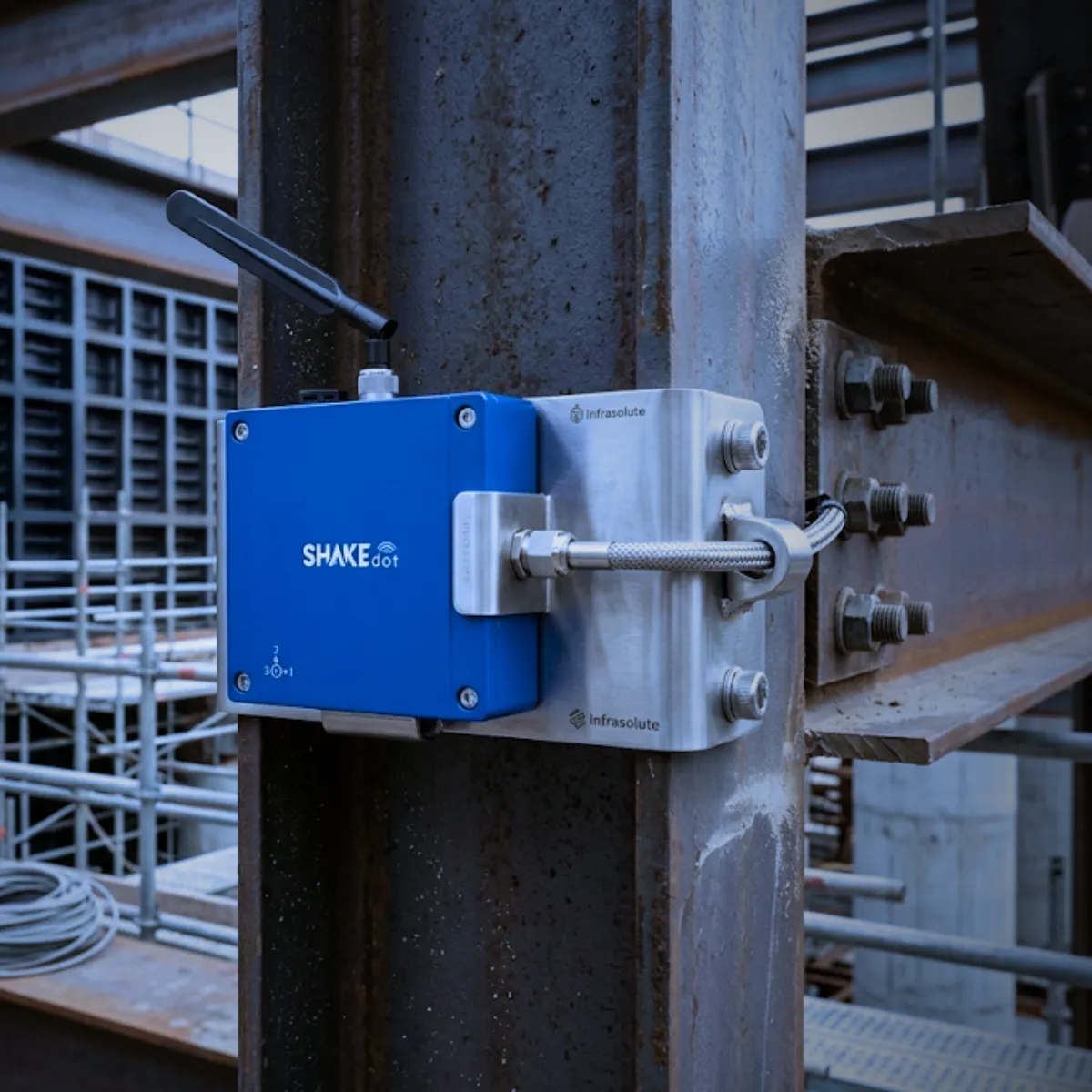
All of this is measured with the vibration sensor SHAKEdot: three-axis, autonomous for up to six months and without cabling on the component.
Standards reference
Assessed against recognised standards
Different sets of rules apply depending on the protection goal. We assign the readings to the relevant reference.
Effects on structures
For structural vibration. Continuous vibration is subject to its own, stricter limits than short-term events.
Effects on people
Assesses the perception and acceptability of vibration for people in buildings.
Machinery & plant
For assessing machine vibration, for example on rotating plant and its foundations.
One point of contact
One point of contact for the entire monitoring programme
You receive vibration monitoring as a complete solution, from the initial concept through to ongoing operation as monitoring as a service.
Concept
We define measured quantities, measuring points and the standard-based assessment framework, tailored to the structure or plant item.
Learn moreInstallation
The wireless sensors are fitted without running cables and commissioned with a documented baseline measurement.
Learn moreMaintenance and operation
As monitoring as a service, we operate the data platform, keep the sensors available and evaluate the data continuously.
Learn moreMonitoring and alerting
Continuous trend monitoring with automatic alerting on any deviation from the learned normal range.
Learn moreApplications
Where permanent vibration monitoring makes sense
Wherever the condition of a structure or plant item must be reliably known over a long period.
- Bridges and civil engineering structures
- Tunnels and railway infrastructure
- Car parks and underground car parks
- Critical infrastructure
- Historic structures
- Industrial plant and machinery
- Crane runways and foundations
- Towers and masts
Vibration monitoring for your structure
Tell us which structure or plant item you want to monitor long-term. We design the right measuring chain and get back to you with a no-obligation quote.
 Benedikt Seuss
Data platform
All readings on one platform
The sensors transmit their readings wirelessly to the data platform, where they are evaluated, documented and continuously checked against your thresholds.
- AI-assisted data analysis
- User-focused reporting
- Continuous evaluation
- Warning and alarm thresholds
- Alerts by email and text message
- Remote access around the clock
- AI-assisted data analysis Condition within limits
- User-focused reporting Report ready
- Alerting Thresholds monitored
Frequently asked questions about vibration monitoring
What is the difference between vibration monitoring and construction vibration monitoring?
How does the system detect structural changes?
Which standards are applied?
How long does vibration monitoring run?
Does permanent operation require power and cabling?
Can vibration monitoring be retrofitted to existing structures?
Project inquiry
Vibration monitoring for your structure
Tell us which structure or plant item you want to monitor long-term. We design the right measuring chain and get back to you with a no-obligation quote.
+49 6742 8599600 DE +41 41 670 00 11 CH [email protected]