

Lifetime & forecast: estimating how a structure will develop
The condition rating shows how a structure was assessed on the inspection day. With data series over months and years, you also see where it is heading. Inspection findings, readings and environmental data allow an estimate of how it will develop, as a range with its assumptions stated.
- Linked to the condition rating
- Trends from long data series
- Forecast as a range
What does a lifetime forecast mean in structural health monitoring?
A lifetime forecast uses continuous measurements to estimate how the condition of a structure or component will develop, and what this means for its remaining service life. It is not a certain prediction but a range under stated assumptions. The longer and more complete the data series, the narrower and more reliable this range becomes.
What the forecast delivers
From current condition to future development
An inspection shows the condition on one day. A data series shows where it is heading.
Trends instead of snapshots
Long data series show whether a crack is growing, moisture is increasing or a component is settling, and how fast.
A range, not a point value
Future development is shown as a range. This keeps visible how certain a statement is.
Context from weather and inspection
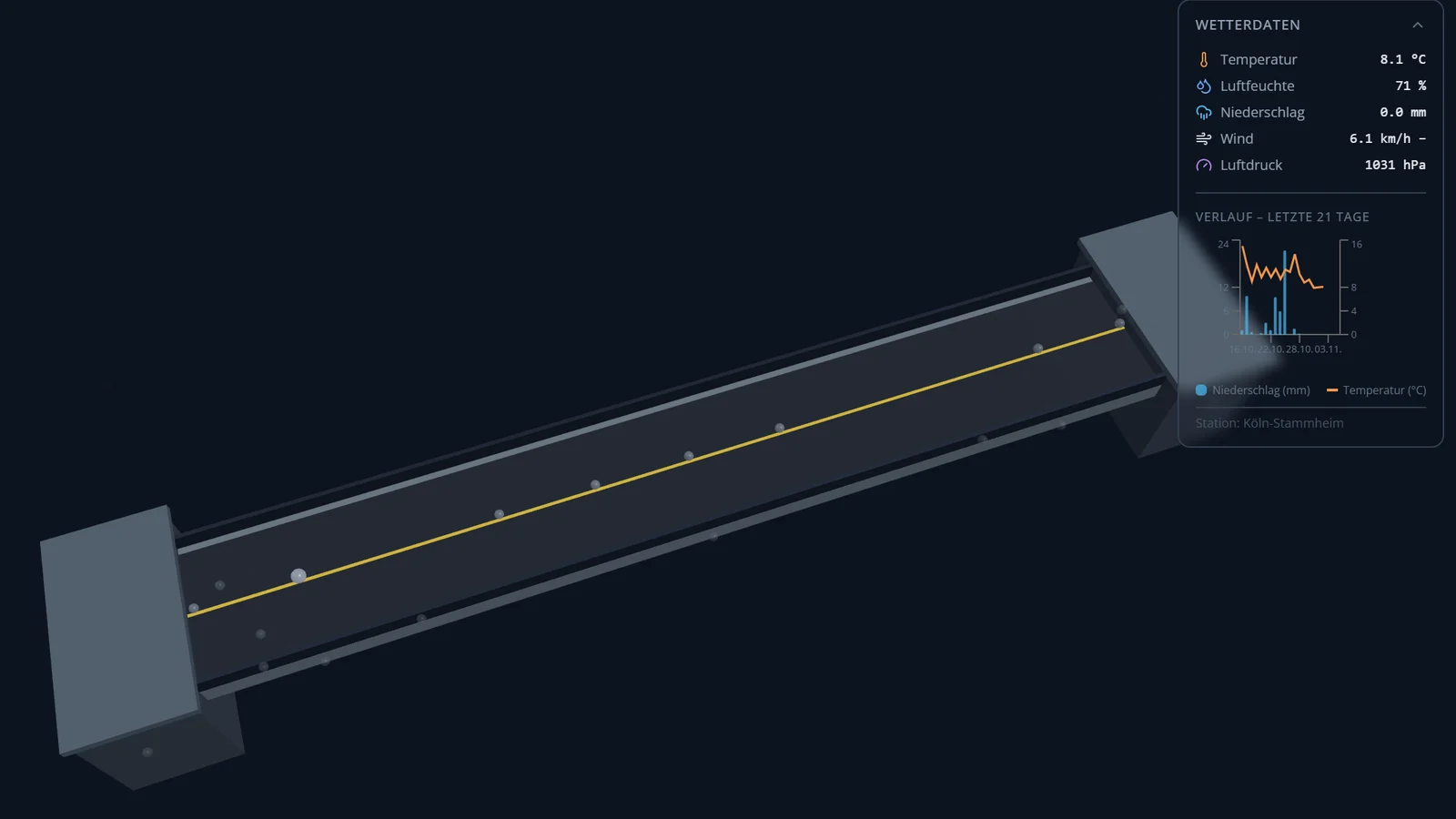
Temperature, rainfall and findings from the structural inspection feed into the assessment.
Basis for maintenance planning
The estimate helps to plan the timing of a repair or an in-depth investigation.
Checking the effect of measures
After a repair the data series shows whether the measure works, for example when sensors confirm that a component is drying out.
Assumptions stated
Every forecast states what it is based on and where its limits are. This makes it verifiable.
Condition rating and forecast
What the condition rating tells you, and what it cannot
In Germany, bridges and other engineering structures are inspected to DIN 1076 and rated under the RI-EBW-PRÜF guideline. The condition rating is the key figure in structure maintenance. To understand what monitoring adds to a forecast, it helps to know how this rating comes about.
Damage assessment: three criteria for every defect
During the inspection, the engineer records each damage and each defect individually. Every damage is assessed against three criteria, each on a scale from 0 to 4. A damage can therefore be insignificant for structural safety and considerable for durability.
Does the structure carry the loads it was designed for? The highest rating calls for immediate measures, up to a restriction of use.
Does the damage put users at risk, for example through loose parts, surface damage or a damaged railing?
Is the fabric preserved so that the structure reaches its planned service life? Moisture, chloride and corrosion show up here first.
From these individual assessments, the condition rating of the structure is calculated using a defined procedure. It ranges from 1.0 to 4.0:
- 1.0–1.4
- very good condition
- 1.5–1.9
- good condition
- 2.0–2.4
- satisfactory condition
- 2.5–2.9
- adequate condition
- 3.0–3.4
- inadequate condition, repair needed without delay
- 3.5–4.0
- unsatisfactory condition, immediate measures required
Weighting: the most severe damage sets the rating
The condition rating is not an average of all defects. The most severely rated damage is decisive; the number and extent of further damage can raise the rating further. A single damage with a high structural safety rating therefore shapes the rating of an otherwise sound structure.
This has two consequences for maintenance. First, the rating shows how urgent a structure is, but not which damage lies behind it, how large it is or what its repair will cost. Second, the rating often depends on just a few locations in the structure. Anyone who wants to maintain or improve it has to keep exactly these locations in view.
This is where monitoring comes in. The measuring points sit where the governing damage sits: at the crack, at the bearing, in the area with moisture and chloride ingress. The damage that sets the rating becomes a measured quantity with a history.
Why the rating alone is not enough
The rating is a snapshot of the inspection day. A principal inspection takes place every six years, with a minor inspection three years later. In between, nobody is at the component with a measuring instrument.
Two structures with the same rating can therefore develop in entirely different ways. In one, a crack has been stable for years; in the other, it opens a little further every month. The rating does not distinguish between the two; the data series does. It is precisely this rate of change that determines urgency, and it is the basis of every forecast.
Many types of damage affect durability first, long before they reach structural safety, for example corrosion inside a prestressed concrete section. Measuring during this phase buys time: for a targeted repair while the damage is still limited, and for maintenance planning that is not caught out by the next inspection.
Looking ahead from the past and the present
A forecast connects three time horizons. The past comes from inspection reports, the history of the condition rating, as-built documents and earlier measurements. They show how the structure has behaved so far. The present comes from the current readings, together with weather data and, where available, traffic data. They show what is happening at the component today.
The trend is derived from both, adjusted for the daily and seasonal temperature cycles. When it is projected forward, the result is not a single line but a range that widens over time. If the monitoring concept defines a threshold, such as a crack width or a moisture value, the range shows the earliest point at which this threshold could be reached. That is the period in which a measure should be planned.
The forecast does not predict the next condition rating. It describes how quickly the measured quantities at the governing damage are changing, giving the inspecting engineer and the operator a sound basis for the next assessment. With every new reading, the range is checked and adjusted where necessary.
How a forecast is made
From data series to estimate
A forecast is only as good as its data. That is why it starts with the monitoring concept, not with the model.
- 01
Define quantities
In the monitoring concept we define which quantities describe the development of the structure, such as crack width, moisture or tilt.
- 02
Build the data series
The sensors record the values over months and years, with weather data as context. Inspection reports and earlier measurements are added as the history.
- 03
Derive the trend
The trend is derived from the data series and separated from weather-related fluctuations.
- 04
Estimate and assess
Engineers estimate future development as a range and assess what it means for use and maintenance.
For whom
For maintenance, planning and budget
For engineers and structural designers
- Measured trends instead of assumptions
- A range with stated assumptions and limits
- Weather-related fluctuations separated from the trend
- Data series as a basis for in-depth investigations
For operators and budget holders
- Better timing of repairs
- Evidence of the effect of measures already taken
- Maintenance budgets based on data
- Transparency towards authorities and committees
Limits of any forecast: A forecast only applies under the stated assumptions and replaces neither the mandatory structural inspection nor a structural assessment. If use, load or environment change, the estimate has to be reassessed.
Read on
Where the data comes from
A forecast needs long, reliable data series. These solutions provide them.
Estimate how your structure will develop
Together we clarify which quantities describe the development of your structure and from when reliable statements are possible.
 Benedikt Seuss

Frequently asked questions: Lifetime & Forecast
What does the condition rating have to do with monitoring?
How is damage assessed under RI-EBW-PRÜF?
Can monitoring predict the remaining service life of a structure?
How long must measurements run before a forecast is possible?
Does a forecast replace the structural inspection?
How is uncertainty handled?
Project inquiry
Request a platform demo
Tell us about the structure, the type of damage and existing monitoring data. We will assess which statements about future development are possible.
+49 6742 8599600 DE +41 41 670 00 11 CH [email protected]